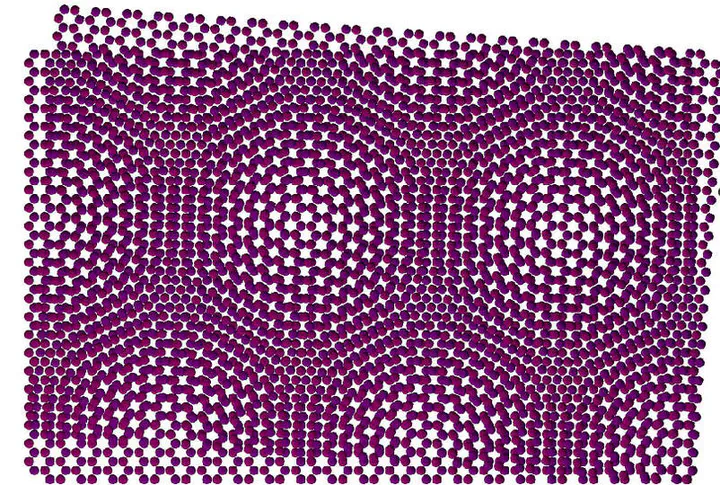
 Photo from phys.org
The investigation of the characteristics of van der Waals heterostructures is a rapidly growing area of research in condensed matter physics, with significant potential but still in its infancy. Graphene, known as a “wonder material” due to its exceptional properties such as superior electrical conductivity compared to copper and strength 200 times that of steel, had yet to exhibit the quantum phenomenon of superconductivity. However, in 2018, a remarkable discovery revealed that superconductivity could be achieved in Twisted Bilayer Graphene, a structure consisting of two layers of graphene placed on top of each other with a rotation angle near the “Magic Angle” of 1.1 degrees. These findings and many others have spurred a surge of research in the field of twistronics in experimental condensed matter physics, leading to the need for optimization and standardization of fabrication procedures for reproducibility and improve the quality of stacks. In this thesis, we aim to standardize the method of fabricating twisted Bilayer Graphene using the modified Dry Stacking Method and the recent technique of tear and stack procedure. We conclude with the successful implementation of a standardized step-by-step procedure for a typical TBLG stack.